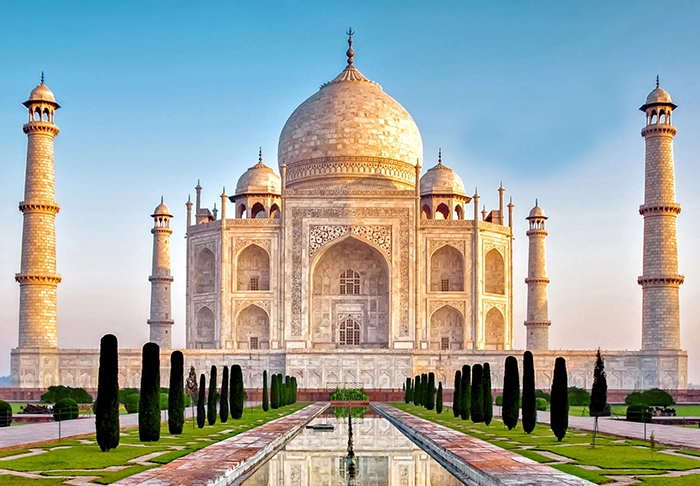
Agra, the ancient capital of the Mughal Empire and home to the world-famous Taj Mahal, has long captivated both Indians and visitors from around the globe. Most of the city lies along the western bank of the Yamuna River, with the Taj Mahal and Agra Fort as its most prominent landmarks.
Founded in the 15th century, Agra came under the control of Babur in 1526. During his reign, the city saw the construction of its earliest fortifications. In the second half of the 16th century, Agra became the official capital of the Mughal Empire, ushering in a golden age of art, architecture, and urban development.
Itimad-ud-Daula
Often referred to by locals as the “Little Taj Mahal,” Itimad-ud-Daula is a striking example of early Mughal architecture, located in the city of Agra.
This elegant mausoleum was commissioned by Nur Jahan, the influential wife of Emperor Jahangir, in memory of her father Mirza Ghiyas Beg, who held the high-ranking title Itimad-ud-Daula, meaning “Pillar of the State.” Mirza Ghiyas Beg was also the father of Asaf Khan and Nur Jahan, and the grandfather of Mumtaz Mahal, in whose honor Emperor Shah Jahan later built the iconic Taj Mahal.
The construction of the tomb complex took place between 1622 and 1628. Both the interior and exterior are richly decorated with inlaid precious stones and gold. One of the most remarkable features of the mausoleum is the early and extensive use of white marble in the main building—a notable departure from the traditional red sandstone used in earlier Mughal architecture.
The entire complex is carefully laid out and consists of:
- Four red sandstone structures positioned at the cardinal points,
- A central white marble mausoleum with four slender minarets,
- Enclosing fortress-style walls, and
- A beautifully landscaped garden overlooking the Yamuna River.
The Itimad-ud-Daula complex not only served as a prototype for the later Taj Mahal but also marks a key transitional moment in Mughal architectural history, blending Persian aesthetics with Indian elements in a way that would influence generations to come.